Good job. Roughly 1/3 of the county (Gaines) where this is happening are illegals/green cardies or Mennonites who are likely unvaccinated. No idea how many more of the general population are also unvaccinated (for measles at least).
Grok explains this VERY well:
If a third of a population—approximately 33%—is unvaccinated for measles, herd immunity is unlikely to be achieved. Measles is one of the most contagious diseases known, with a basic reproduction number (R0) of 12 to 18, meaning each infected person can spread it to 12 to 18 others in a fully susceptible population. For herd immunity to interrupt transmission, a very high percentage of the population must be immune, typically through vaccination or prior infection.
The threshold for herd immunity depends on the disease’s contagiousness and is calculated using the formula: 1 - (1/R0). For measles, taking an R0 of 15 (a midpoint estimate), the threshold is 1 - (1/15) = 14/15, or about 93.3%. This means at least 93% to 94% of the population needs immunity to prevent outbreaks. If 33% are unvaccinated, only 67% are vaccinated (assuming full immunity from the vaccine and no natural immunity from prior infection). This falls well short of the 93% to 94% required, leaving the population vulnerable.
Even with a lower R0 estimate of 12, the threshold would be 1 - (1/12) = 11/12, or about 91.7%. A 67% vaccination rate still doesn’t reach this, and measles’s airborne transmission and long infectious period amplify the gap. Real-world data backs this: outbreaks, like the one in Gaines County in 2025, often occur in communities with vaccination rates below 90%, especially where unvaccinated individuals cluster, as seen with the local Mennonite population.
Herd immunity also assumes random mixing and uniform vaccine efficacy (the MMR is about 97% effective after two doses). If the unvaccinated third is evenly distributed, the risk rises; if clustered (e.g., in a tight-knit community), outbreaks become even more likely. So, with 33% unvaccinated, herd immunity isn’t feasible—measles would likely spread unless other factors (like isolation or prior infections) significantly boost immunity, which isn’t typical in modern, vaccine-reliant populations.


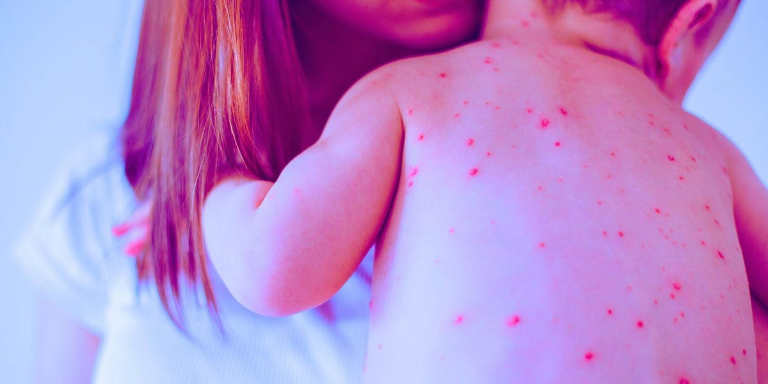
Good job. Roughly 1/3 of the county (Gaines) where this is happening are illegals/green cardies or Mennonites who are likely unvaccinated. No idea how many more of the general population are also unvaccinated (for measles at least).
Grok explains this VERY well:
If a third of a population—approximately 33%—is unvaccinated for measles, herd immunity is unlikely to be achieved. Measles is one of the most contagious diseases known, with a basic reproduction number (R0) of 12 to 18, meaning each infected person can spread it to 12 to 18 others in a fully susceptible population. For herd immunity to interrupt transmission, a very high percentage of the population must be immune, typically through vaccination or prior infection.
The threshold for herd immunity depends on the disease’s contagiousness and is calculated using the formula: 1 - (1/R0). For measles, taking an R0 of 15 (a midpoint estimate), the threshold is 1 - (1/15) = 14/15, or about 93.3%. This means at least 93% to 94% of the population needs immunity to prevent outbreaks. If 33% are unvaccinated, only 67% are vaccinated (assuming full immunity from the vaccine and no natural immunity from prior infection). This falls well short of the 93% to 94% required, leaving the population vulnerable.
Even with a lower R0 estimate of 12, the threshold would be 1 - (1/12) = 11/12, or about 91.7%. A 67% vaccination rate still doesn’t reach this, and measles’s airborne transmission and long infectious period amplify the gap. Real-world data backs this: outbreaks, like the one in Gaines County in 2025, often occur in communities with vaccination rates below 90%, especially where unvaccinated individuals cluster, as seen with the local Mennonite population.
Herd immunity also assumes random mixing and uniform vaccine efficacy (the MMR is about 97% effective after two doses). If the unvaccinated third is evenly distributed, the risk rises; if clustered (e.g., in a tight-knit community), outbreaks become even more likely. So, with 33% unvaccinated, herd immunity isn’t feasible—measles would likely spread unless other factors (like isolation or prior infections) significantly boost immunity, which isn’t typical in modern, vaccine-reliant populations.