Marx's ideas were created in the 16th century by the Jesuits and perfected by them in South America over a span of 2 centuries using the indigenous people as guinea pigs. They separated the women from the men and the children from their parents and put them all in separate housing in reductions. The Jesuits then began reeducating them against the monarchy, taught them the art of warfare, armed them, and led them in an attack against the government. As a result of this treasonous act, the Jesuits were expelled from South America. Former Secretary of the United States Navy, Richard W. Thompson, describes these events in the 10th chapter of his book, Footprints of the Jesuits.
Fast-forward to Marx....At the British Museum, which was run by the Jesuits, Marx learned from them:
how to inflame the rage of the people with division caused by constant civil agitation,
how to lead people to blame their monarchies and governments in general for all the evils in their respective nations; and
how to use the manufactured rage of the people to overturn governments the Jesuits wanted to get rid of, just like the Jesuits did in South America, then in France, and in Russia, and now in the United States.
The Jesuits were--and still are--actively involved in the process of dismantling governments all over the world using "Marx's" ideology.
They now call the stages of said process "social justice" (this is the stage in which they divide society into factions over manufactured social issues, all of which are blamed on the government) and "liberation theology" (this is the stage in which they lead society into open revolt and/or guerrilla warfare to topple targeted governments).
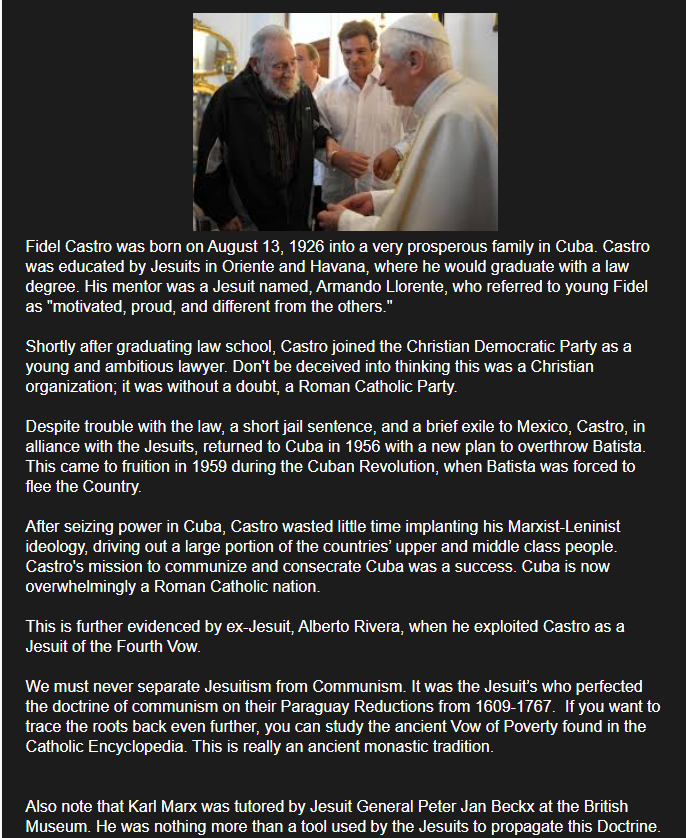
Fidel Castro's Childhood-the untold story Few Catholics probably realise just how deep the Communist icon's religious convictions and beliefs ran underneath Fidel Castro's public Marxist persona. Yet new research examines those early formative Catholic experiences that created the character and personal psychology of the revolutionary leader who 50 years ago this year, brought the World to the brink of nuclear Armageddon as America and the Soviet Union prepared to launch intercontinental ballistic missiles at each other. America had previously regarded Cuba as a possession run by puppet politicians who allowed organised crime to set up in Cuba to launder criminal proceeds through brothels, Casinos and a disregard for the poor, former slaves, and ordinary Cubans excluded from the wealth generated by sugar production. The sugar industry has always been a mainstay of Cuba's economy but until the 1959 revolution it was under monopoly ownership by American companies, exporting the lucrative crop and the profits it generated back to America. Fidel Castro cites his Catholic upbringing and then his Jesuit tutors at colleges in Santiago and Havana in Cuba as the cornerstone of his convictions to liberate Cuba from foreign colonial rule and improve conditions for the poor, slaves and socially excluded ordinary people of Cuba. A close advisor once told a visiting journalist that Castro was badly misunderstood: " What people don't realise is that Fidel is a Jesuit first and foremost, a Nationalist second, and then third a Marxist". In 1992, for the very first time, Fidel visited the small farmhouse where his father Angel was born in Galicia. This journey is sometimes called a homing instinct, or a desire to connect with the past, especially deceased parents, or ancestral locations. It speaks of a desire to understand oneself, so we can imagine Fidel at the age of sixty-four seeking something that could explain himself to himself, to answer questions he had been asking for decades, to make some sort of sense of himself. It is often forgotten that just before this 'pilgrimage' both his step-siblings Pedro and Lidia had died and we know that the death of older relatives is a reminder of one's own mortality that can stimulate someone to undertake such a long-harboured mission. He is quoted at the time of this almost spiritual journey as reflecting on his father's character, recalling the kindness he showed his estate labourers, his father's homesickness, and of course his father's violent temper, reprimands, and perhaps most poignantly his father's sadness.
Castro teachers were Franco leaning anti-communists:
The Jesuits were nearly all Spanish. [...] Politically all the Jesuits he encountered were right-wing, and supporters of Franco in the Spanish Civil War.
What converted Castro was the Communist Manifesto, not Jesuits material. One would need to bring at least a Jesuits book/teacher that led Castro inevitably to Communism. His link between "Christianism" and "Communism" is better described below.
At university Castro became a Marxist-Leninist. "To be quite frank, the simplicity, clarity and direct manner in which our world and society are explained in the Communist Manifesto had a particularly great impact on me," he said.
One would need a list of all people that were affected and check if Jesuits were affected or not, or if they actually gained from the revolution. That would be at least a "cui bono" of their participation on the revolution.
In the other hand if Jesuits were actually expelled, demoted, or hindered in general, is at least a good indication that the revolution was not a Jesuits one.
After the revolution no churches in Cuba were ever closed down, he said, but he had requested that some of the priests be withdrawn, because of the militant attitude taken by some in opposing the revolution, especially the Spanish ones.
Their authorisation to stay in the country was revoked, but replacements were allowed. Religious-run schools and hospitals were nationalised, and believers in God were not allowed join the communist party.
What Castro is saying here is closer to "Liberation Theology", than Jesuits. And "Liberation Theology" is very close to KGB.
It very well known that Communist "Catholics" in South America are all close to "Liberation Theology".
Rather, she said, "I concentrated on the revolutionary aspects of Christian doctrine and Christ's thinking."
Christ didn't choose the rich to preach his teaching, he recalled, "he chose 12 poor and ignorant workers, that is, he chose the proletariat of the times . . . They were poor people, very poor, without exception."
Of course, that from the Protestant perspective the Catholic Church is wrong for centuries, so nothing will change one mind. But we don´t need to exaggerate.


http://www.puritans.net/news/castro.htm
ICYMI the Jesuits and Communism https://greatawakening.win/p/19A12tNri2/new-study-finds-crazy-jew-did-no/c/
https://thejesuitcontinuumomegapoint.blogspot.com/2014/06/jesuit-origins-of-communism-part-1.html
Marx's ideas were created in the 16th century by the Jesuits and perfected by them in South America over a span of 2 centuries using the indigenous people as guinea pigs. They separated the women from the men and the children from their parents and put them all in separate housing in reductions. The Jesuits then began reeducating them against the monarchy, taught them the art of warfare, armed them, and led them in an attack against the government. As a result of this treasonous act, the Jesuits were expelled from South America. Former Secretary of the United States Navy, Richard W. Thompson, describes these events in the 10th chapter of his book, Footprints of the Jesuits.
Fast-forward to Marx....At the British Museum, which was run by the Jesuits, Marx learned from them:
The Jesuits were--and still are--actively involved in the process of dismantling governments all over the world using "Marx's" ideology.
They now call the stages of said process "social justice" (this is the stage in which they divide society into factions over manufactured social issues, all of which are blamed on the government) and "liberation theology" (this is the stage in which they lead society into open revolt and/or guerrilla warfare to topple targeted governments).
https://www.irishtimes.com/news/castro-confesses-to-jesuit-ethics-while-eschewing-religious-belief-1.126168
Wait til you see the post I'm cooking next!
https://www.newadvent.org/cathen/12327a.htm
https://web.archive.org/web/20100420012507/https://www.catholic.org/encyclopedia/view.php?id=9553
https://archive.org/details/doctrineofjesuit00bert/page/548/mode/2up?q=poverty (this whole book is astounding)
some more on castreo
Fidel Castro's Childhood-the untold story Few Catholics probably realise just how deep the Communist icon's religious convictions and beliefs ran underneath Fidel Castro's public Marxist persona. Yet new research examines those early formative Catholic experiences that created the character and personal psychology of the revolutionary leader who 50 years ago this year, brought the World to the brink of nuclear Armageddon as America and the Soviet Union prepared to launch intercontinental ballistic missiles at each other. America had previously regarded Cuba as a possession run by puppet politicians who allowed organised crime to set up in Cuba to launder criminal proceeds through brothels, Casinos and a disregard for the poor, former slaves, and ordinary Cubans excluded from the wealth generated by sugar production. The sugar industry has always been a mainstay of Cuba's economy but until the 1959 revolution it was under monopoly ownership by American companies, exporting the lucrative crop and the profits it generated back to America. Fidel Castro cites his Catholic upbringing and then his Jesuit tutors at colleges in Santiago and Havana in Cuba as the cornerstone of his convictions to liberate Cuba from foreign colonial rule and improve conditions for the poor, slaves and socially excluded ordinary people of Cuba. A close advisor once told a visiting journalist that Castro was badly misunderstood: " What people don't realise is that Fidel is a Jesuit first and foremost, a Nationalist second, and then third a Marxist". In 1992, for the very first time, Fidel visited the small farmhouse where his father Angel was born in Galicia. This journey is sometimes called a homing instinct, or a desire to connect with the past, especially deceased parents, or ancestral locations. It speaks of a desire to understand oneself, so we can imagine Fidel at the age of sixty-four seeking something that could explain himself to himself, to answer questions he had been asking for decades, to make some sort of sense of himself. It is often forgotten that just before this 'pilgrimage' both his step-siblings Pedro and Lidia had died and we know that the death of older relatives is a reminder of one's own mortality that can stimulate someone to undertake such a long-harboured mission. He is quoted at the time of this almost spiritual journey as reflecting on his father's character, recalling the kindness he showed his estate labourers, his father's homesickness, and of course his father's violent temper, reprimands, and perhaps most poignantly his father's sadness.
Marx and Beckx http://www.noiseofthunderradio.com/noise-of-thunder-radio-show/2019/7/30/notr-jesuits-make-the-catholic-case-for-communism-73019.html
Audio (30mins) http://s3.media.squarespace.com/production/827989/9727427/JESUITS.COMMUNISM_07.30.2019.mp3?AWSAccessKeyId=AKIAIGASFZJDTI4L3CAA&Signature=zHGF6H0bqM1zvCrebbYXvlSOdQI%3D&Expires=1744195072
Great documentary about the jesuits in America.
https://rumble.com/v6qdv80-american-jesuits-a-history-of-jesuitism-in-the-united-states-chris-pinto.html
The jesuits are a perfidious group. Well done OP for drawing attention to them.
All commies are tools.
Also note that Adolf Hitler was also in jail for a short time in the 1920s. He was exiled after World War II.
Castro teachers were Franco leaning anti-communists:
What converted Castro was the Communist Manifesto, not Jesuits material. One would need to bring at least a Jesuits book/teacher that led Castro inevitably to Communism. His link between "Christianism" and "Communism" is better described below.
One would need a list of all people that were affected and check if Jesuits were affected or not, or if they actually gained from the revolution. That would be at least a "cui bono" of their participation on the revolution.
In the other hand if Jesuits were actually expelled, demoted, or hindered in general, is at least a good indication that the revolution was not a Jesuits one.
What Castro is saying here is closer to "Liberation Theology", than Jesuits. And "Liberation Theology" is very close to KGB.
https://www.catholicnewsagency.com/news/former-soviet-spy-we-created-liberation-theology-83634
It very well known that Communist "Catholics" in South America are all close to "Liberation Theology".
https://www.irishtimes.com/news/castro-confesses-to-jesuit-ethics-while-eschewing-religious-belief-1.126168
Communist infiltration predates the Cuban Revolution by decades: https://www.churchmilitant.com/video/episode/vortex-the-church-has-been-infiltrated
Of course, that from the Protestant perspective the Catholic Church is wrong for centuries, so nothing will change one mind. But we don´t need to exaggerate.
Communist material is Jesuit material! That's the play--Marx was merely a convenient proxy for their own ideas. Read the last parts of the image. This comment has more on it https://greatawakening.win/p/19Ax7FCeCy/x/c/4eRUGIVGJNc?d=50
You may also be interested in this free Jesuit publication https://greatawakening.win/p/19Ax2bxgVN/i-found-an-actual-currentday-com/c/ in their own words, read any issue I bet you'll find communist nudgings woven through it.
There are a lot of masonic lodges in Cuba….