


As part of its watchdog work, ICAN routinely monitors suspicious health organizations and NGOs. The latest organization on our radar is the Johns Hopkins Institute for Vaccine Safety (IVS). IVS claims its mission is providing “independent” assessments of vaccine safety to assist the public with healthcare decision-making. However, ICAN’s initial investigation revealed remarkably close ties with CDC, bringing into question the true nature of its “independence” regarding vaccine safety.
IVS first hit ICAN’s radar when a controversial vaccine safety article was published in the New England Journal of Medicine last July and the lead author was IVS’s director, Daniel Salmon. Despite its name, and despite the subject of that article, IVS has very little to do with monitoring vaccine safety. Instead, ICAN has uncovered what appears to be its main goal: simply assuring everyone that vaccines are safe. Almost all IVS employees have close ties to the government, and some possess serious conflicts of interest with pharma.
For example, while Salmon (who is not an MD) previously served as the Director of Vaccine Safety for HHS’s National Vaccine Program Office, he has also served as an advisor on policy boards for Janssen, Sanofi, and Moderna. Salmon devotes a lot of time to researching and writing about vaccine policy, not vaccine safety. The IVS site even has a special section devoted to discrediting religious objections to vaccines. Tellingly, it appears the “independent” IVS received its startup financial support from vaccine manufacturers in 1997 and 1998.
According to the IVS website, the institute is necessary because “government officials are often restricted in what they can say or release.” Interestingly, IVS’s vaccine information seems to closely mirror CDC recommendations and, in some cases, is copied verbatim from the CDC website. Is it coincidental then that the only two medical doctors on staff at IVS have strong ties to CDC? Or that Johns Hopkins has received over $259 million dollars from CDC (and over $4 billion from NIH) in the last 5 years alone?
It is clear that IVS is not an “independent” source of medical and scientific knowledge. It is plainly yet another covert government platform that has been perpetuating CDC’s vaccine narrative for decades. ICAN intends to find out how deep this improper relationship goes. To that end, our attorneys have issued FOIA requests to CDC regarding IVS. When we learn more, we will be sure to let you know.
Coincidence? Discern for yorselves. Not here to argue just sharing. https://www.youtube.com/watch?v=UiWv6h3574E


nobody knew who the WEF was before Event 201
at the very bottom of this page, there are 6 videos.
i highly recommend you watch all 6 videos...
https://centerforhealthsecurity.org/our-work/tabletop-exercises/event-201-pandemic-tabletop-exercise
"The year is 2020 ..." - Food Chain Reaction: A Global Food Security Game
The year is 2020. Our global food system is under stress. All countries are experiencing mounting pressures.
Under this scenario, a group of leaders from government, the private sector, international institutions and NGOs will engage in a simulation to determine how they will react as the food supply becomes increasingly destabilized.
What gaming can teach us about food security? - WEF, Dec 2015
I just spent 10 years dealing with some of the worst food shocks in world history. It began when El Niño obliterated crops in Australia and India, and drought struck North America. America’s farm belt was hit by floods just a couple of years later. I watched with dismay as food stocks fell and prices skyrocketed. Countries eased environmental laws to help farmers maximize yields, yet food security still dipped across Africa, Europe and Asia. Some nations crumbled under the weight of civil unrest and hunger.
Then things got really bad.
Fortunately, all of this actually happened over the course of two days this November. It was a game.
Food production is not only made vulnerable by climate change, but it also drives climate change. According to the World Resources Institute, agriculture is responsible for 24% of all human-caused greenhouse gas emissions. The UN’s Food and Agriculture Organization estimates that we’re using about 38% of the planet’s land to produce food.
Food Chain Reaction—A Global Food Security Game
The Center for American Progress, World Wildlife Fund, Cargill, Mars, and CNA developed and executed a policy decision-making game designed to explore issues arising from, and possible responses to, global food system disruptions.
The game took place in November 2015 in Washington, D.C., and included senior officials and subject matter experts on teams representing Brazil, Continental Africa, China, the European Union (EU), India, the United States, Multilateral Institutions, and Businessand Investors.
During four rounds of game play spanning the decade 2020 to 2030, players confronted food system pressure at the intersection of population growth, urbanization, severe weather, and social unrest. In response, players crafted policies, made decisions, and took actions that dynamically influenced the state of the world as the game advanced.
As the chain reaction of impacts tied to their choices becameapparent, players experienced first-hand how their decisions and actions influenced global food security. At the conclusion of the game, players highlighted significant lessons learned and expressed increased preparedness to collaboratively address food security.
2016 Cargill asked: What would happen if a global food crisis pushed prices up 400%?
The truth about corporations taking over Ukrainian agricultural lands
“Your money is not charity, it’s an investment.” That’s what Ukrainian President Volodymyr Zelensky said in his address to the U.S. Congress while visiting Washington

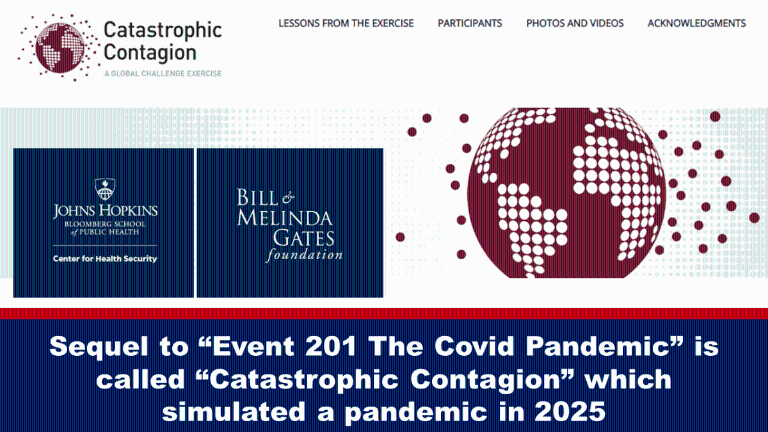
EVENT 201 REDUX
https://www.centerforhealthsecurity.org/our-work/exercises/2022-catastrophic-contagion/
https://evidencenotfear.com/catastrophic-contagion-center-for-health-security/
https://www.youtube.com/watch?v=M-skwhRFWe0&ab_channel=centerforhealthsecurity
*The Johns Hopkins Center for Health Security, in partnership with WHO and the Bill & Melinda Gates Foundation, conducted Catastrophic Contagion, a pandemic tabletop exercise at the Grand Challenges Annual Meeting in Brussels, Belgium, on October 23, 2022. * The extraordinary group of participants consisted of 10 current and former Health Ministers and senior public health officials from Senegal, Rwanda, Nigeria, Angola, Liberia, Singapore, India, Germany, as well as Bill Gates, co-chair of the Bill & Melinda Gates Foundation.
*The exercise simulated a series of WHO emergency health advisory board meetings addressing a fictional pandemic set in the near future. Participants grappled with how to respond to an epidemic located in one part of the world that then spread rapidly, becoming a pandemic with a higher fatality rate than COVID-19 and disproportionately affecting children and young people. * *Participants were challenged to make urgent policy decisions with limited information in the face of uncertainty. Each problem and choice had serious health, economic, and social ramifications. *



[Food Chain Reaction: What Our Food Supply Will Look Like in 2020] from 2015' (https://www.youtube.com/watch?v=f03OtxEKXXY) https://www.youtube.com/watch?v=f03OtxEKXXY
*The global food system is under increasing stress. To address population growth in Africa and Asia and changing consumption patterns, agricultural production will need to substantially increase by 2050. This increase must occur despite a shrinking rural labor force, limited availability of new farmland, growing water stress, and increasing risks from climate change. Numerous demographic, political and social, economic and trade, energy, environmental, and national security and diplomacy factors present significant challenges and opportunities to ensuring global food security for the next 10 years and beyond.
On November 9-10, 2015, more than forty players representing key national, international, and private sector decision makers met in Washington, D.C. for the Food Chain Reaction simulation. The two-day event aimed to examine how to prepare for and mitigate against long-term and deepening disruption of the global food system.
Before game play began, players watched this dramatization of a fictional news cast from the year 2020 about the state of the world's food system.*
https://www.cargill.com/story/food-chain-reaction-simulation-ends-with-global-carbon-tax
Food Chain Reaction crisis simulation ends with global carbon tax Climate, hunger, civil unrest and spiking food prices came together at the Food Chain Reaction game in Washington DC this week. Cooperation mostly won the day. November 12, 2015 On Monday and Tuesday, 65 international policymakers, academics, business and thought leaders gathered at the World Wildlife Fund’s headquarters in Washington DC to game out how the world would respond to a future food crisis.
**The game took the players from the year 2020 to 2030. As it was projected, the decade brought two major food crises, with prices approaching 400 percent of the long term average; a raft of climate-related extreme weather events; governments toppling in Pakistan and Ukraine; and famine and refugee crises in Bangladesh, Myanmar, Chad and Sudan. ** inpage-food-chain-reaction Climate, hunger, civil unrest and spiking food prices came together at the Food Chain Reaction game in Washington DC this week. Cooperation mostly won the day. Along with WWF, the Center for American Progress and the Center for Naval Analyses, Cargill was one of Food Chain Reaction’s organizers. The company was represented in the game by Corporate Vice President Joe Stone.
More: https://www.cargill.com/story/food-chain-reaction-simulation-ends-with-global-carbon-tax